
Imagine you are standing in the Courtauld Gallery in London, in front of the last major painting Manet finished before he died. It is called A Bar at the Folies-Bergère. Painted in 1882, a year before his death, oil on canvas, 96 by 130 centimetres. A barmaid stands behind a marble counter. Behind her, a mirror reflects the room. Champagne bottles, a crystal bowl of oranges, a single pink rose in a glass, a crowd of people in a bright hall lit by gas and chandeliers. Everything looks correct, until you start looking at the reflection. Then it falls apart.
You are standing in front of the woman. You are looking straight at her. So in the mirror behind her, you should see the back of her head. You do. But you should not see yourself in the mirror at all. And in the mirror, on the right side of the canvas, you can see a man in a top hat leaning in toward her, mid-conversation. That man is not in the room. That man is you.
What Manet Painted and What He Broke
This is the trick that has kept art historians arguing for over a hundred years. Manet studied perspective carefully. He knew the rules. The mirror in the painting is not a mistake — it is a deliberate contradiction, and it puts the viewer in two places at once. In front of the barmaid and reflected behind her. Facing her and watching her from the side. The viewer is the customer, and the viewer is also the painter, and the viewer is also the man in the mirror, who is not quite any of them.
The woman at the centre is named Suzon in the studies that survive. She was a real barmaid at the Folies-Bergère on rue Richer in Paris, a music hall that Manet visited often in his last years. She stands with both hands on the marble counter, leaning slightly forward, her body facing us, her expression neutral. She is not smiling. She is not seductive. She is not looking away. She is doing her job, and her eyes are on the customer in front of her, and the customer is you.
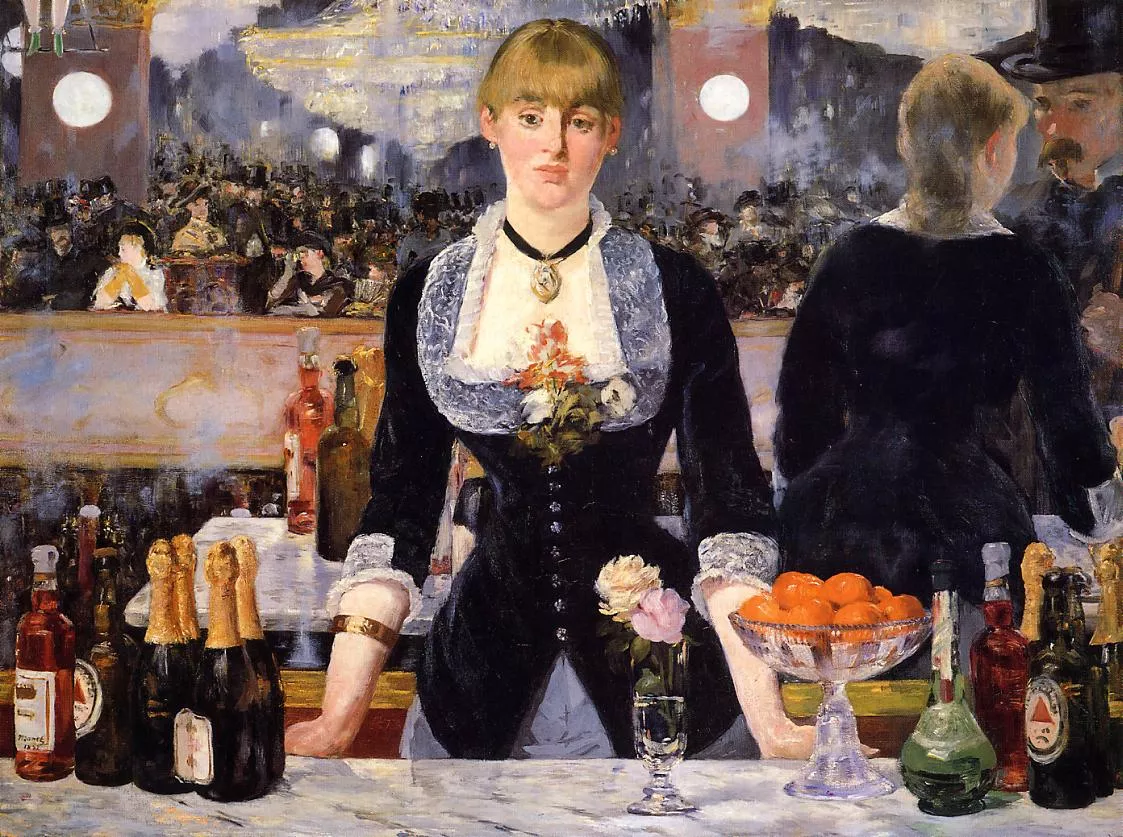 A Bar at the Folies-Bergère, 1882. Oil on canvas, 96 by 130 centimetres. Courtauld Gallery, London. Manet's last major painting before his death.
The Counter and the Reflection
Look at the counter first. Marble top, pale grey with darker veining. On it - a glass of champagne with two straws, a small vase with a pink rose, a crystal bowl filled with bright orange citrus, and around twenty bottles of champagne, beer, and liqueur at various stages of fullness. Manet painted each bottle as a distinct object, each with its own label, its own colour of glass, its own reflection on the marble. He painted the bottles the way a still-life painter would, with care.
Then look up into the mirror. The entire background of the painting is the reflection in the mirror, and the mirror is where the space of the painting actually lives. You can see the marble counter edge reflecting the bottles, the barmaid's back, the man in the top hat, the crowded hall, and, at the very top left corner, two green feet hanging in the air. Those feet belong to a trapeze artist performing above the crowd, out of frame, and they are the only piece of the room that exists without a reflection. Manet painted them in green silk stockings, and they are the size of a thumbnail in the finished canvas.
The details in the mirror do not line up with the perspective in front. The bottles on the counter are in one place, and their reflections are in another. The man in the mirror leans in from the right, but the viewer is standing directly in front of the barmaid. The marble edge in the mirror reflects at a different angle from the marble edge under the barmaid's hands. None of this is accidental, and none of it is a mistake.
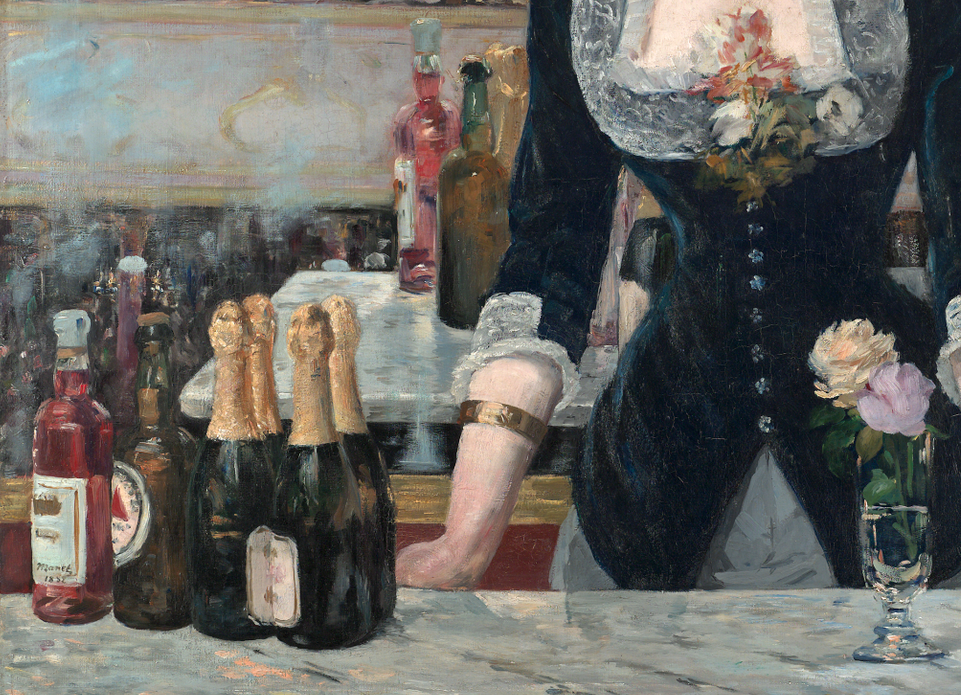 Each bottle is painted as a separate object, with its own glass, label, and reflection on the marble. Source: Courtauld Gallery, London.
The Face That Gives Nothing Away
Look at the woman's face. She is young, maybe twenty. Round cheeks, pale skin with a slight flush, a small mouth, and eyes that are pale blue or grey, difficult to say. Her hair is pulled back and held with a small ribbon, with a fringe across her forehead. She wears a black velvet bodice with a lace collar, a small gold pendant on a black ribbon, and a corsage of flowers pinned at the centre of her chest. She is dressed for the job, not for a portrait.
Manet painted her face flat, the way he painted Olympia's. There is no modelling in the cheeks, no soft transition from light to shadow. The features are drawn, not carved. The eyes have a single small highlight in each, no iris reflection, no shine. The lips are closed, no expression. The face is the calmest thing in the painting, and it is surrounded by noise. All the movement, the crowd, the bottles, the chandeliers, the trapeze feet, everything in the mirror is in motion or glittering and the face at the centre of it does not move.
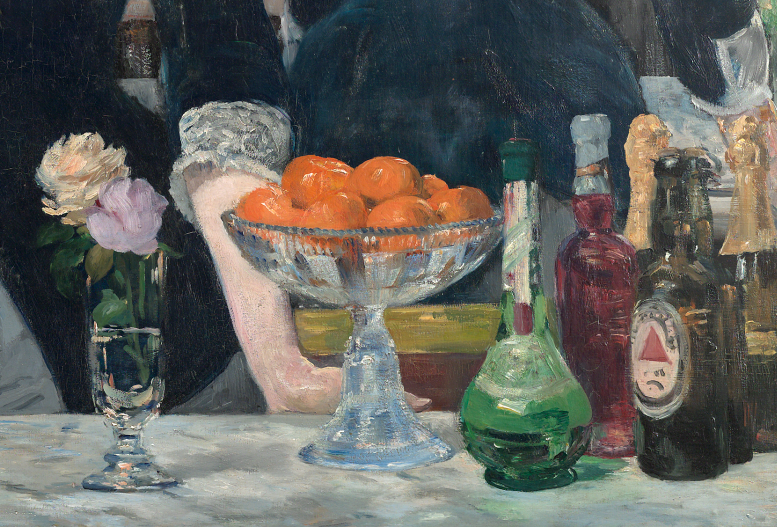 The oranges in the cut-glass bowl are the brightest colour on the canvas. Source: Courtauld Gallery, London.
This is the same calm Manet used seventeen years earlier in Olympia. A face that refuses to perform for the viewer. A gaze that is direct without being inviting. He did it with a nude in 1863 and he did it with a barmaid in 1882, and it still works, because the trick is not the subject. The trick is the flatness of the paint and the way it holds the eyes.
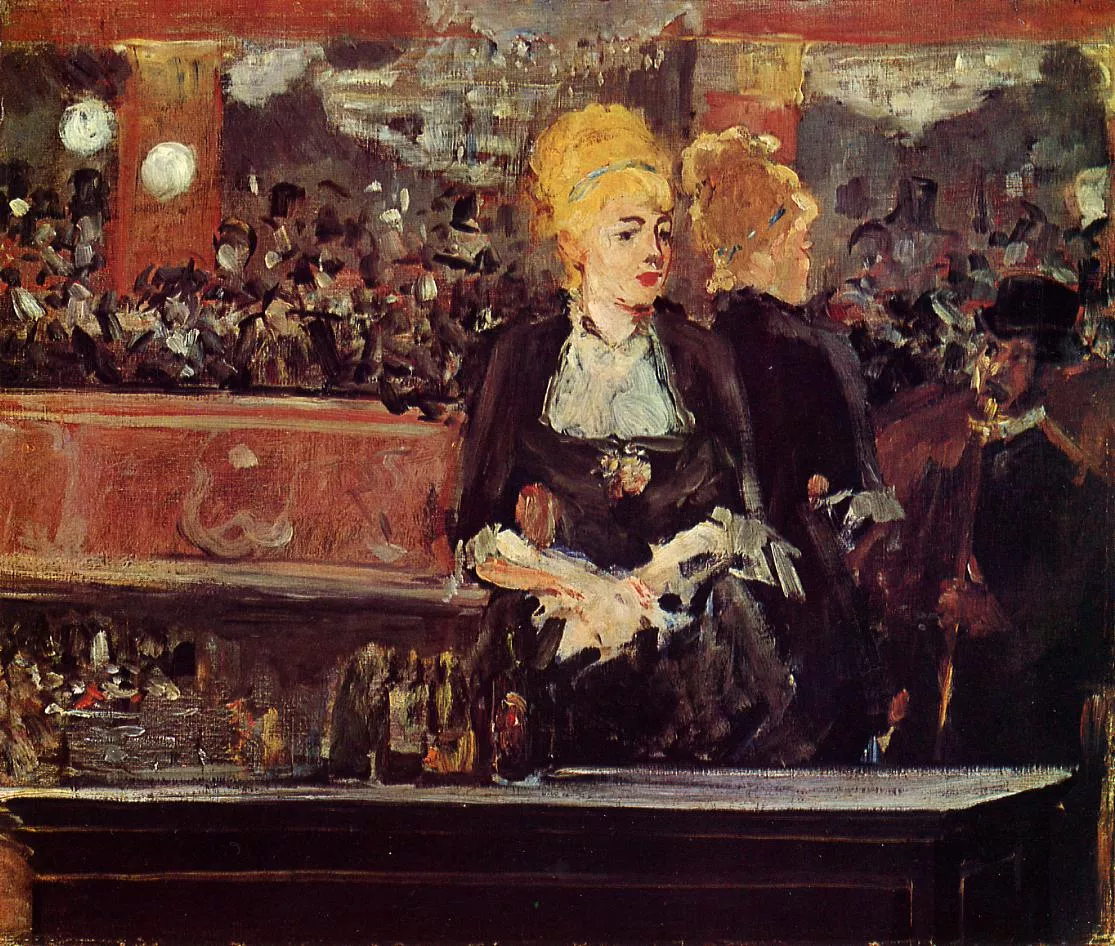 Study for A Bar at the Folies-Bergère. Manet made several studies for the painting in 1881 and 1882. In the studies, the barmaid is placed differently, and the mirror is less contradictory.
Why a Print Collapses the Painting
The whole painting is built on a mirror that does not work, and a print flattens it into a picture of a woman behind a bar. The contradictions between the counter and the reflection disappear on paper, because paper has no depth. The bottles become a decorative band across the bottom, the crowd becomes a texture of dots, and the barmaid becomes a portrait of a sad girl. Everything the painting does with space, with the viewer's two positions, with the viewer being the man in the mirror and also the person standing in front of the barmaid, that entire structure is invisible in print.
A hand-painted oil reproduction rebuilds the surface in the order Manet worked. The bottles and the marble first, painted with the same attention to each object. Then the barmaid's body and dress, then the reflection in the mirror, working the crowd in loose strokes and the chandelier lights in small dabs. Then the face last, flat, calm, with the single small highlight in each eye. The result keeps the tension between the solid world in front and the mirror behind, and it keeps the viewer standing in two places at once. That tension does not survive a print.
See A Bar at the Folies-Bergère as a hand-painted oil reproduction at oilpaintings.com. The bottles are painted first, the reflection second, the face last, exactly as Manet painted them. View the painting
What to Look For If You Ever See It
Start with the marble edge in the mirror and the marble edge under the barmaid's hands. Trace them both. You will see that they cannot exist in the same room. Then look at the man in the mirror on the right. He is the viewer, and the viewer is you, and you are also standing in front of the barmaid, and none of this is possible. Then look at the green shoes in the top left corner. Then look back at the face. It has not changed. It will not change.
Manet painted this canvas in 1882, at the age of fifty, already ill with the syphilis that would kill him the following year. His left leg was partly paralysed, and he worked sitting down. The painting was exhibited at the Salon in 1882 and hung high on the wall, above a door. It is now at the Courtauld Gallery in London. Of everything he made, it is the painting that most clearly shows how far his flatness had taken him and how much he could still do with a mirror and a woman who refuses to perform.
Images: Manet Art (manetart.org) and the Courtauld Gallery, London. Crops from the original painting in the Courtauld collection.